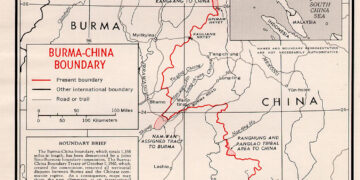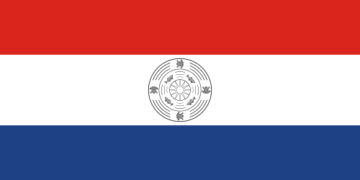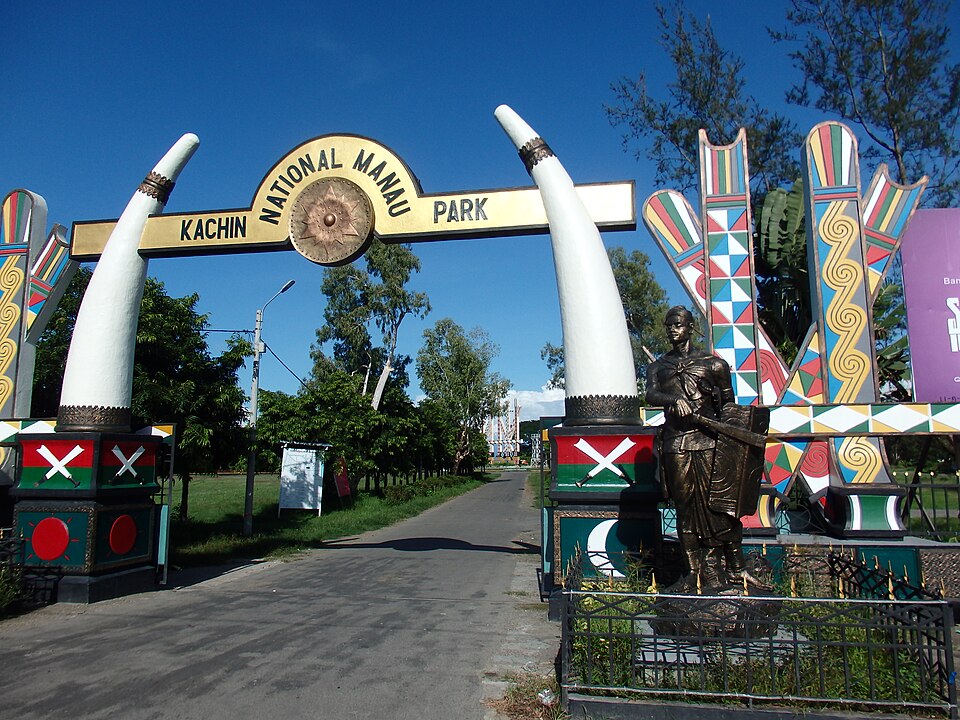
Kachin State is the northernmost state of Myanmar. It is bordered by China to the north and east (Tibet and Yunnan, respectively), Shan State to the south, and Sagaing Region and India (Arunachal Pradesh) to the west. It lies between north latitude 23° 27′ and 28° 25′ longitude 96° 0′ and 98° 44′. The area of Kachin State is 89,041 km2 (34,379 sq mi). The capital of the state is Myitkyina. Other important towns include Bhamo, Mohnyin and Putao.
Kachin State has Myanmar’s highest mountain, Hkakabo Razi at 5,889 metres (19,321 ft), forming the southern tip of the Himalayas, and a large inland lake, Indawgyi Lake. It also has the most national parks of any administrative division in Myanmar, that being three.
History
Kingdom of Nanzhao
Main article: Nanzhao
The Nanzhao Kingdom controlled much of Upper Burma, including modern-day Kachin State.[3] The kingdom also used the territory as a staging ground to invade the Pyu city-states in modern-day Sagaing.[4] E.R. Leach claimed that the Chinese referred to the Jingpo as Pu Man (蒲蠻) as a leftover from Nanzhao descriptions of Mon-Khmer speakers. However, there is little evidence to support this assertion.[5]

Kingdom of Dali
Main article: Dali Kingdom

After the fall of the Nanzhao Kingdom, the Dali Kingdom administered the lands inhabited by the Kachin people.[5]
Kingdom of Möng Mao
Main article: Möng Mao

During the 14th-century, Möng Mao used the territories of modern-day Kachin State to launch incursions into Yunnan.[6]
Under Qing dynasty of China

The Qing dynasty of China briefly controlled the present Kachin state during the 1760 Sino-Burmese War.
What is now Kachin State was historically inhabited by a diverse population of various ethnolinguistic groups, including the Rawang, the Lisu, the Jingpo, the Zaiwa, the Lashi/Lachik and the Lawngwaw/Maru, all of whom had overlapping territories and varying social structures.[7][8] The term “Kachin” is a term given by the British during the colony period referring to ethnic groups living between the central Bamar heartland to the south and China to the north.
Traditional Kachin society was based on shifting hill agriculture. According to “The Political Systems of Highland Burma: A Study of Kachin Social Structure”, written by E. R. Leach, Kachin was not a linguistic category. Political authority was based on chieftains who depended on support from immediate kinsmen. Considerable attention has been given by anthropologists of the Kachin custom of maternal cousin marriage, wherein it is permissible for a man to marry his mother’s brother’s daughter, but not with the father’s sister’s daughter. In pre-colonial times, the Kachin were animist.
After the 1760s Qing-Konbaung war, the Chinese exercised a degree of control over the present-day northeastern Kachin State. During the British colonization of Burma, the Kachin Hills tribal autonomy was accepted by the British government. British forces carried out two expeditions against the Kachin in 1892 and 1896. In 1910, the British occupied Hpimaw (Pianma) in the Pianma Incident.[9]
Post-independence Burma
The pre-independence Burmese government under Aung San reached the Panglong Agreement with the Shan, Kachin, and Chin peoples on 12 February 1947. The agreement accepted “Full autonomy in internal administration for the Frontier Areas” in principle and envisioned the creation of a Kachin State by the Constituent Assembly. Burma attained independence on 4 January 1948. Kachin State was formed in the same year out of the former British Burma civil districts of Bhamo and Myitkyina, together with the larger northern district of Puta-o. Kachin State was officially announced on 10 January 1948 and Kachin State Government held “Mungdaw Masat Masat Manau” (forming of Kachin State Manau) for three consecutive days since 9 to 11 January as happiness since that year they held Manau on 10 January every year until the 1962 Burmese coup d’état.[10] The vast mountainous hinterlands are predominantly Kachin, whereas the more densely populated railway corridor and southern valleys are mostly Shan and Bamar. The northern frontier was not demarcated until the 1960s. Various Chinese governments had claimed the northern-half of Kachin State as Chinese territory since the 18th century.[citation needed] Before the British rule, roughly 75% of all Kachin jadeite ended up in China, where it was prized much more highly than the local Chinese nephrite.
Kachin conflict
Main article: Kachin conflict
The complex political situation started when the Kachin armed group was established on 25 October 1960, after the UN government announced the state religion as Buddhism, as the Kachin people stopped believing in the government administration system, established after the federal union was agreed upon in the 1947 Panglong agreement. Between 1962 and 2010, the military government ruled over Myanmar. Cease fire agreements between ethnic armed groups and the government were made starting in 1989. And then in 2011 the new government led by President Thein Sein, broke the cease fire agreement which was agreed upon by the former military government and the Kachin ethnic armed group in 1994, resuming fighting against the Kachin who are living in the northern part of Myanmar, northern part of Shan, near the China border on 9 June 2011. Because of the abrupt internal conflict, thousands of internally displaced people fled to refugee camps which are located in the government-controlled area as well in the Kachin Independence Army controlled area (Hlaing, 2005).
Kachin troops formerly formed a significant part of the Burmese army. With the unilateral abrogation of the Union of Burma constitution by the Ne Win regime in 1962, Kachin forces withdrew and formed the Kachin Independence Army (KIA) under the Kachin Independence Organization (KIO). Aside from the major towns and railway corridor, Kachin State has been virtually independent from the mid-1960s through 1994, with an economy based on agriculture and trade with China, including of jade. After a Myanmar army offensive in 1994 seized the jade mines from the KIO, a peace treaty was signed, permitting continued KIO effective control of most of the State, under aegis of the Myanmar military. This ceasefire immediately resulted in the creation of numerous splinter factions from the KIO and KIA of groups opposed to the SPDC‘s controversial peace accord, and the political landscape remains highly unstable.

KIO made a ceasefire agreement with the military government in 1994 while leaving political issues to be discussed with the next elected government. Throughout its struggle, both in the ceasefire and non-ceasefire period, KIO also made agreements with other ethnic rebels and alliances including the Democratic Alliance of Burma (DAB), the National Democratic Front (NDF), and United Nationalities Federal Council (UNFC). The main goal was to pressure the military government and restore the federal democratic government with greater autonomy to Kachin State. During its 17 years of ceasefire from 1994 to 2011 the KIO actively participated in the military-led constitution-drafting-process, attending the National Convention, which was boycotted by the democratic icon Aung San Suu Kyi’s National League for Democracy and ethnic political parties. The KIO together with 12 other ethnic groups demanded amendments of the draft to be more in line with a federal democratic system and to give autonomy to states (Zaw Oo & Win Min 2007).
The seventeen-year ceasefire broke down and fighting between the Kachin Independence Organization and the government resumed in June 2011 after the Kachin Independent Army disallowed the government’s order to transform into a Border Guard Force and it claimed that the regime’s 2008 Constitution lacked federal democratic principles and equal political rights for ethnic minorities based on the Panglong Agreement. Renewed fighting between the Kachin Independence Army and the Burmese army began on 9 June 2011 at Ta-pein hydropower plan and continued throughout 2012. Initial reports suggested that from June to September 2011 a total of 5,580 Internally Displaced Persons from 1,397 households arrived at 38 IDP camps under Myanmar Government control.[11] In August 2012 thousands of Kachin refugees were forced by the Chinese Government back into Myanmar despite the continued fighting there; NGOs like Human Rights Watch called to cease such action and pointed the illegality of doing so under international law.[12] As of 9 October 2012, over 100,000 IDPs are taking shelter in various camps across Kachin State. The majority of IDPs (est. 70,000) are currently sheltering in KIA controlled territory.[13] Fatality estimates were difficult to estimate but most reports suggested that between government troops, Kachin Independence Army rebels, and civilians upwards of 1,000 people had died in the conflict.
Even though many Kachins were already displaced internally, only around 150,000 people are reported as IDPs. The Kachins are currently the major target for the Burmese government,[citation needed] yet relatively few Kachins have chosen to resettle in countries such as the United States or Australia, in comparison to other Myanmar ethnic minorities, such as the Karens and Chins.
Government

The Kachin State Government consists of an executive (Kachin State Government), a legislature (Kachin State Hluttaw), and a judiciary.
Demographics
In 2014, Kachin State had a population of 1,689,441.
| Year | Pop. | ±% |
|---|---|---|
| 1973 | 737,939 | — |
| 1983 | 904,794 | +22.6% |
| 2014 | 1,689,441 | +86.7% |
| Source: 2014 Myanmar Census[1] | ||
Ethnic makeup
Further information: Ethnicity in Myanmar
| Ethnic group | Percentage | |||
|---|---|---|---|---|
| Kachin | 39.6% | |||
| Bamar | 32.6% | |||
| Shan | 22.6% | |||
| Other | 4.3% | |||
| Rakhine | 0.4% | |||
| Karen | 0.3% | |||
| Chin | 0.2% | |||
| Source: 2019 GAD township reports | ||||
The Kachin make up a slight plurality of Kachin State’s population, while the Bamar and Shan comprise significant minorities, making up almost half of the state’s population.
After the 2014 Census in Myanmar, the Burmese government indefinitely withheld release of detailed ethnicity data, citing concerns around political and social concerns surrounding the issue of ethnicity in Myanmar.[14] In 2022, researchers published an analysis of the General Administration Department‘s nationwide 2018-2019 township reports to tabulate the ethnic makeup of the Kachin State.[15][14]
| Ethnic group | 2019 | 2016[16] | 1983 | 1973 |
|---|---|---|---|---|
| Kachin | 39.6 | – | 38.1 | 39.1 |
| Bamar | 32.6 | 29.2 | 29.3 | 24.2 |
| Shan | 22.6 | 23.6 | 24.2 | 26.6 |
| Jingphaw | – | 18.97 | – | – |
| Lisu | – | 7.0 | – | – |
| Rawam | – | 5.0 | – | – |
| Lawwaw | – | 3.33 | – | – |
| Lacheik | – | 2.89 | – | – |
| Zaikwa | – | 1.57 | – | – |
| Others | 4.3 | 8.56 | 7.2 | 1.9 |
| Rakhine / Arakanese | 0.4 | – | 0.2 | 0.1 |
| Kayin / Karen | 0.3 | – | 0.3 | 0.3 |
| Chin | 0.2 | – | 0.7 | 0.8 |
Religion

According to the 2014 Myanmar Census, Buddhists, who make up 64.0% of Kachin State’s population, form the largest religious community there.[17] Religious minority communities include Christians (33.8%), Muslims (1.6%), Hindus (0.4%), and animists (0.2%) who collectively comprise the remainder of Kachin State’s population.[17] 2.8% of the population listed no religion, other religions, or were otherwise not enumerated.[17]
| Religious group | Population % 1983 | Population % 2015[17] |
|---|---|---|
| Buddhism | 58.5% | 64.0% |
| Christianity | 38.5% | 33.8% |
| Hinduism | 1.8% | 0.4% |
| Islam | 0.5% | 1.6% |
| Other | 0.7% | 0.2% |
According to the State Sangha Maha Nayaka Committee‘s 2016 statistics, 7,966 Buddhist monks were registered in Kachin State, comprising 1.5% of Myanmar’s total Sangha membership, which includes both novice samanera and fully-ordained bhikkhu.[18] The majority of monks belong to the Thudhamma Nikaya (95.3%), followed by the Shwegyin Nikaya (4.7%), with the remainder of monks belonging to other small monastic orders.[18] 1,103 thilashin were registered in Kachin State, comprising 1.8% of Myanmar’s total thilashin community.[18]